
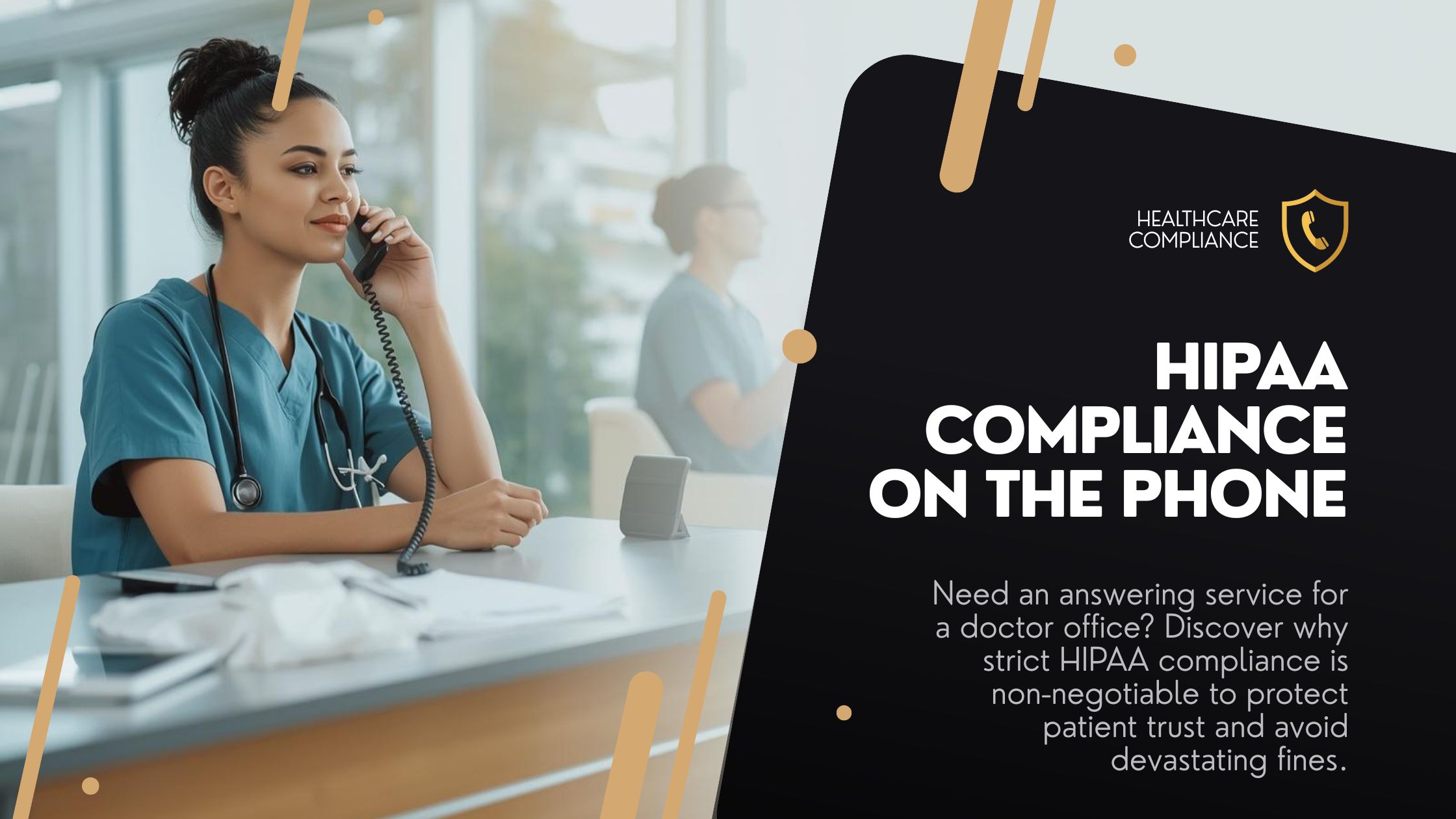
The “check engine” light of medical practice management rarely flashes when the waiting room is full and the doctors are rounding. It usually illuminates long after the last employee has locked the front door.
It happens when a post-op patient develops an infection over a holiday weekend. It happens when an expectant mother starts experiencing concerning symptoms long before the clinic opens. In healthcare, the need for communication doesn’t respect business hours, which is why having an after-hours safety net is essential.
But here is the critical distinction between a thriving medical practice and a massive liability: catching the call is only half the battle. How that call is handled is where the real danger lies.
When a patient reaches out in distress, they aren’t just leaving a message; they are transmitting highly sensitive, legally protected information. They are sharing their medical history, their current symptoms, their prescriptions, and their fears. In the eyes of the law, the moment your after-hours representative hears that information, the clock on HIPAA compliance starts ticking.
If the answering service you’ve hired, and the technology they utilize, isn’t built from the ground up to comply strictly with the Health Insurance Portability and Accountability Act (HIPAA), your practice is operating with a glaring, dangerous blind spot.
When searching for an answering service for a medical office, HIPAA compliance is not a premium feature or an optional upgrade. It is the absolute, non-negotiable foundation of the service. Let’s explore why treating compliance as an afterthought is the most expensive mistake a medical practice can make, and what genuine security demands when your office is closed.
The Reality of After-Hours Calls (and the Hidden Risks)
Running a medical office is exhausting. Between navigating insurance claims, managing staff schedules, and ensuring doctors can actually focus on treating patients, the administrative burden is immense. It is incredibly tempting to look for the cheapest, fastest solution when setting up your after-hours communications.
Many doctors and office managers assume that any standard call center can handle message taking. “Just take a name, a number, and tell the doctor,” the logic goes. But healthcare doesn’t work like ordering a pizza or booking a hotel.
When a standard, non-medical answering service takes a message, they often write it down on a piece of paper, type it into an unsecured email, or shoot a standard text message (SMS) directly to the on-call doctor’s personal cell phone.
Every single one of those actions is a HIPAA violation.
Standard SMS text messages are not encrypted. Unsecured emails can be intercepted. A piece of paper sitting on a generic call center desk can be seen by anyone walking by. If an auditor or a disgruntled patient discovers that your answering service for a doctor office is playing fast and loose with PHI, the Office for Civil Rights (OCR) isn’t going to punish the answering service. They are going to penalize you.
The True Cost of a Generic Service: Fines, Audits, and Nightmares
Let’s talk about the elephant in the room: the financial and legal ramifications of a HIPAA breach.
HIPAA violations are categorized into tiers based on the level of negligence. If you hire a generic answering service and fail to verify their compliance, you are likely looking at “Willful Neglect.” Fines for these tiers can range from hundreds of dollars to over $50,000 per violation, with an annual maximum of $1.5 million.
But the check you have to write to the government is only the beginning of the nightmare.
Consider the operational paralysis of a HIPAA audit. Your entire staff will be pulled away from patient care to pull records, answer questions, and implement corrective action plans. You will likely need to hire expensive legal counsel specializing in healthcare compliance.
Then, there is the breach notification rule. If patient data is compromised because your answering service’s unsecured server was hacked, you are legally required to notify the affected patients, the Secretary of Health and Human Services, and, if the breach affects more than 500 residents of a state, prominent media outlets.
Imagine the headline in your local newspaper: “Local Doctor’s Office Exposes Hundreds of Patients’ Medical Records.” It takes years of compassionate care to build a stellar reputation in your community, and only one unsecured text message to shatter it completely.
Beyond the Fines: The Human Element of Patient Trust
While the threat of massive fines is enough to make any practice manager sweat, there is a much more human reason why HIPAA compliance is non-negotiable. It boils down to one word: Trust.
Think about what your patients share with you. They tell you about their mental health struggles, their chronic illnesses, their physical insecurities, and their fears. They undress in your exam rooms and answer incredibly invasive questions. They do this because there is an unspoken (and legally binding) pact that their vulnerabilities will be fiercely protected.
When a patient calls your office after hours, they are often scared, in pain, or anxious. They expect the person answering the phone to treat their information with the exact same reverence and security as the doctor sitting in the exam room.
If your answering service for a medical office is not HIPAA compliant, you are betraying that trust. You are taking the deeply personal information a patient just shared in a moment of panic and tossing it into the digital wind. A truly compliant medical answering service understands the weight of this responsibility. They don’t just see “data”; they see a human being’s private life, and they guard it accordingly.
What Does True HIPAA Compliance Look Like in an Answering Service?
So, how do you separate the professionals from the pretenders? Many call centers will slap a “HIPAA Compliant” badge on their website, but true compliance goes much deeper than a logo. When you are vetting an answering service for a doctor office, you need to look for these concrete, non-negotiable pillars of security:
1. The Business Associate Agreement (BAA)
This is the absolute dealbreaker. Under HIPAA regulations, an answering service is considered a “Business Associate” of your “Covered Entity” (your medical practice). A BAA is a legally binding contract that outlines exactly how the answering service will handle, protect, and dispose of PHI. It holds them legally accountable for safeguarding your patients’ data. If an answering service hesitates, makes excuses, or refuses to sign a BAA, hang up the phone immediately. They are not the partner for you.
2. End-to-End Encryption and Secure Messaging
As mentioned earlier, standard SMS text messaging is the enemy of HIPAA. A compliant answering service will never text patient details to an on-call physician’s standard messaging app. Instead, they utilize secure, encrypted messaging applications. These apps require a secure login, encrypt the data both in transit and at rest, and often feature remote-wipe capabilities so that if a doctor loses their phone, the patient data can be instantly destroyed.
3. Rigorous, Ongoing Staff Training
Technology is only as secure as the humans operating it. A compliant medical answering service doesn’t just train their operators once during onboarding; they mandate ongoing, rigorous HIPAA training. These operators are specifically trained as medical dispatchers. They know how to calm a distressed patient, how to accurately record complex medical terminology, and, crucially, what information is safe to share and what must be restricted.
4. Physical and Network Security
Compliance isn’t just about software. It’s about where the operators physically sit. A secure facility restricts access to authorized personnel only. Operators shouldn’t have cell phones or recording devices at their desks. The network itself must be fortified with enterprise-grade firewalls, regular security audits, and secure servers that are protected against ransomware and cyberattacks.
5. Proper Data Archiving and Disposal
What happens to a message after the doctor reads it? HIPAA dictates strict rules for how long PHI must be retained and exactly how it must be destroyed. A compliant service will have automated, secure archiving systems and protocols to permanently wipe data when it is no longer needed, ensuring there are no loose ends left floating in the cloud.
Peace of Mind is Priceless
Running a medical practice today is harder than it has ever been. Between staffing shortages, declining reimbursements, and the ever-present threat of litigation, you have enough on your plate.
You cannot afford to lie awake at night wondering if the temporary operator who just answered your clinic’s phone wrote a patient’s HIV status on a Post-it note, or if they just texted a patient’s psychiatric history over an unsecured network.
Choosing an answering service is an extension of your practice. They are the first voice your patients hear in their most vulnerable moments, and they are the guardians of your practice’s legal standing when your doors are locked.
Investing in a dedicated, strictly HIPAA-compliant answering service for a medical office is not an administrative expense; it is a vital insurance policy. It protects your bottom line, it protects your medical license, and most importantly, it protects the deeply sacred trust your patients place in you every single day.
Ready to sleep soundly knowing your patients and your practice are fully protected?
Don’t leave your after-hours calls to chance. At Answer United, we specialize in providing secure, empathetic, and strictly HIPAA-compliant answering services for medical practices of all sizes. From secure text messaging to highly trained medical operators, we handle your patients with the care and confidentiality they deserve. Contact Answer United today to build a customized, secure communication plan for your doctor’s office.