When someone calls your company, what happens?
Ideally, a knowledgeable person answers quickly, understands what the caller needs and moves the conversation forward. In reality, calls often reach voicemail, ring through several extensions or interrupt an employee who is already helping another customer.
That is where answer services come in.
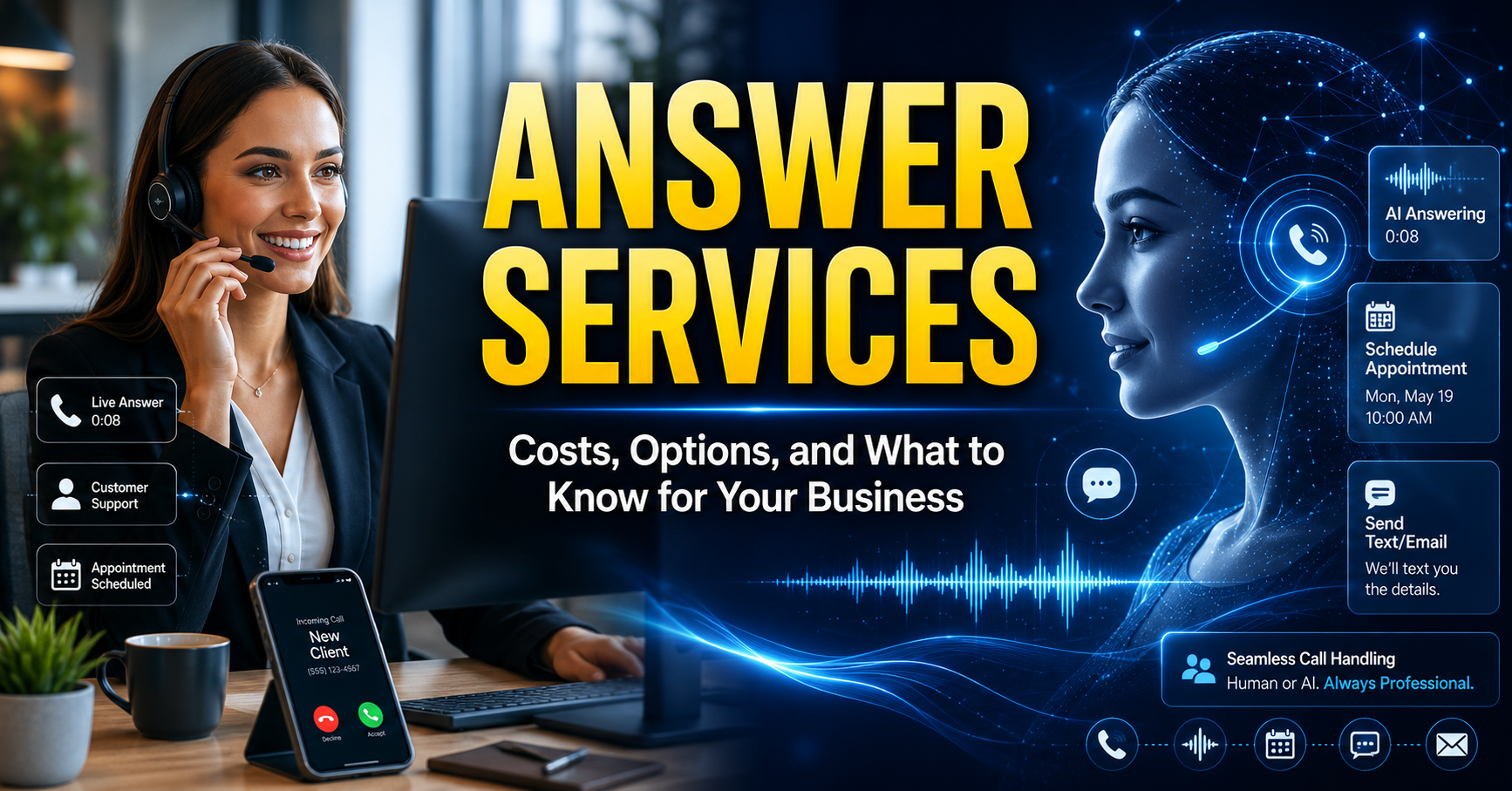
Answer services, more commonly called answering services, help companies manage incoming calls without requiring every call to be handled by an employee sitting inside the business. Depending on the service, calls may be answered by a live receptionist, an AI receptionist, a dedicated remote employee, an automated phone system or a combination of people and technology.
Modern business answering services can do far more than take messages. They can qualify leads, schedule appointments, answer common questions, route emergencies, process orders, collect payments, update a CRM, send text messages and transfer important callers to the right employee.
The challenge is that the term “answer services” now covers several very different solutions. A $25 AI answering service is not the same product as a $700 live virtual receptionist plan. A basic message-taking service is not the same as an outsourced contact center.
This guide explains the available answer services, what they cost, what customers tend to like and dislike, and how to select the right service for your company.
What Are Answer Services?
Answer services are third-party people, software platforms or phone systems that answer incoming business calls when a company’s employees are unavailable, busy or not expected to handle calls directly.
The industry-standard term is “answering services,” but people also search for:
- Answer services
- Business answer services
- Call answer services
- Phone answering services
- Telephone answering services
- Live answering services
- Virtual receptionist services
- After-hours answering services
- AI answering services
- 24-hour answering services
Search engines generally understand that these phrases describe the same broad category. However, individual providers may offer dramatically different levels of service.
Some answer services simply record a caller’s name, telephone number and message. More advanced answering services can act like an external front desk, following detailed instructions for different callers, departments, locations and situations.
Quick Comparison of Business Answer Services
| Type of answer service | How calls are handled | Typical use | Relative cost |
|---|---|---|---|
| Business voicemail | Callers leave recorded messages | Very low call volume | Lowest |
| Auto attendant or IVR | Callers choose from a telephone menu | Basic call routing | Low |
| AI answering service | Conversational software answers and completes routine tasks | High-volume, repetitive inquiries | Low to moderate |
| Live answering service | Shared human agents answer using a script | Message-taking, overflow and after-hours calls | Moderate |
| Virtual receptionist service | Human receptionists perform intake, scheduling and transfers | Professional services and lead-driven businesses | Moderate to high |
| Hybrid AI and human service | AI handles routine calls and humans take exceptions | Companies balancing cost and service quality | Moderate |
| Dedicated remote receptionist | One person or small team is assigned to the company | Complex workflows and brand consistency | High |
| Outsourced contact center | A larger team handles service, sales and multiple communication channels | High call volume and ongoing customer support | Highest |
| In-house receptionist | A company employee answers calls and performs office duties | Businesses requiring on-site support | High fixed cost |
The best answer services are not necessarily the ones with the most features. The best choice is the service that matches your call volume, customer expectations, industry requirements and revenue opportunity.
The Main Types of Answer Services
1. Voicemail Services
Voicemail remains the simplest way to handle unanswered calls. The caller hears a recorded greeting, leaves a message and waits for someone to return the call.
Voicemail is inexpensive and familiar, but it puts almost all the work on the caller. The caller must explain the situation without receiving confirmation, answers or help.
Voicemail may be enough for a consultant, freelancer or small operation that receives very few calls. It is usually a weak choice for emergency services, legal intake, medical scheduling, home services, real estate, property management or any company where a caller may contact the next available provider.
2. Automated Attendants and IVR Systems
An auto attendant answers with a prerecorded greeting and asks callers to select an extension or department.
For example:
“Thank you for calling Greenfield Plumbing. Press 1 to schedule service. Press 2 for an existing appointment. Press 3 for billing.”
Automated attendants are primarily routing systems. They may reduce interruptions, but they generally do not hold a real conversation, interpret unusual requests or reassure an upset caller.
An auto attendant can work well when callers already know who or what they need. It can become frustrating when callers have complex questions or cannot identify the correct option.
3. AI Answering Services
An AI answering service uses conversational voice technology to answer incoming calls. Unlike a traditional menu, modern AI receptionists allow callers to speak naturally.
An AI answering service may be able to:
- Answer frequently asked questions
- Identify why the person is calling
- Collect contact information
- Qualify leads
- Book, reschedule or cancel appointments
- Send text messages
- Provide directions or business hours
- Transfer calls
- Create call summaries
- Update a CRM or scheduling platform
- Handle multiple calls simultaneously
Current AI answer services can be significantly less expensive than human answering services. Upfirst, for example, publishes a $34.95 monthly plan for 30 calls, while Zoom lists an AI Receptionist plan at $35 per month when billed annually, including 100 minutes. RingCentral has published AI Receptionist pricing beginning at $49 per month with 100 minutes.
AI answering services are especially useful when calls are repetitive. A dental practice may receive dozens of calls about insurance, office hours and appointment availability. An HVAC company may repeatedly answer questions about service areas, emergency availability and diagnostic fees.
The primary weakness is judgment. AI can follow instructions quickly, but unusual, emotional, confidential or high-risk conversations may still require a person. The call center industry is increasingly using AI for routine interactions while reserving sensitive and complex situations for trained human agents.
4. Live Answering Services
A live answering service uses real people to answer calls on behalf of multiple companies. Agents typically see the company’s greeting, script and instructions when a call arrives.
A basic live answering service may:
- Answer in the company’s name
- Take a message
- Ask several intake questions
- Determine whether the call is urgent
- Transfer the call
- Notify an employee by text or email
Live answering services are often used for overflow coverage, lunch breaks, evenings, weekends and holidays.
The major advantage is the human interaction. A trained agent can recognize confusion, frustration or urgency and adapt the conversation.
The major disadvantage is usage-based cost. Many live answer services charge by the minute, by the call or through a monthly package with overage fees.
5. Virtual Receptionist Services
A virtual receptionist service is a more advanced form of live answering service. Instead of simply taking messages, virtual receptionists are expected to act like an extension of the company’s front desk.
Virtual receptionist services may handle:
- Detailed lead intake
- Consultation scheduling
- Appointment changes
- Warm call transfers
- New customer qualification
- Existing customer support
- Payment collection
- Order processing
- Outbound follow-up calls
- Bilingual calls
- CRM data entry
- Live website chat
The line between an answering service and a virtual receptionist service is not always clear. In general, answering services focus on receiving and routing calls. Virtual receptionists perform a wider set of front-office tasks.
6. Hybrid AI and Human Answer Services
Hybrid answer services use AI for common calls and human receptionists for situations that require judgment.
For example, an AI receptionist may answer the call, identify the caller and answer basic questions. It may then transfer a qualified sales opportunity, emergency or complicated request to a live receptionist.
This structure can reduce costs without forcing every caller through a fully automated experience.
Hybrid services are often a strong fit for companies with high call volume and a mix of simple and complex calls. The key is ensuring that callers can reach a person without becoming trapped in an automated conversation.
7. Dedicated Remote Receptionists
A dedicated remote receptionist works for the company from another location. Unlike shared answering service agents, a dedicated receptionist may spend all or most of the workday supporting one business.
This option provides greater familiarity with the company, employees, customers and internal processes. It can be useful for companies with complex scheduling, extensive product knowledge or recurring customers who expect continuity.
Dedicated support costs more than shared answer services because the company is paying for reserved labor rather than occasional call time.
8. Outsourced Contact Centers
A contact center is a broader operation that may handle calls, email, live chat, text messages, technical support, order management and outbound customer communication.
Contact centers are generally appropriate for larger organizations, ecommerce businesses, software companies, franchises and companies with substantial customer service volume.
An answering service answers calls. A contact center manages a larger portion of the customer relationship.
How Much Do Answer Services Cost?
Answer service pricing can range from less than $25 per month to several thousand dollars per month.
The price depends on whether calls are handled by AI or people, how usage is measured, how much work happens during each call and whether the service requires specialized agents.
Current published prices illustrate the size of the range.
| Provider or service | Published starting option | Service model |
| Upfirst | $24.95 per month for 30 calls | AI answering service |
| Zoom AI Receptionist | $25 per month, billed annually, for 100 minutes | AI receptionist |
| RingCentral AI Receptionist | Starting at $39 per month with 100 minutes | AI receptionist |
| ReceptionHQ | From $25 per month for message-taking | Live answering |
| Moneypenny | AI plans from $84 and human answering from $132 per month | AI, human and hybrid |
| Davinci Virtual | Approximately $129 to $319 per month | Live virtual receptionist |
| Ruby | $250 per month for 50 receptionist minutes | Live virtual receptionist |
| PATLive | $75 per month plus $2.60 per minute, or $250 for 75 minutes | Live answering |
| Smith.ai | $300 per month for 30 live receptionist calls | Live virtual receptionist |
Pricing is a July 2026 snapshot and is not a ranking or endorsement. Providers can change plans, features and promotional rates.
Common Answering Service Pricing Models
Per-Minute Pricing
The company pays for the amount of time an agent spends handling calls. A plan may include a certain number of minutes, followed by an overage rate.
Per-minute pricing can be efficient when calls are short. It can become expensive when agents perform detailed intake, scheduling or customer support.
Per-Call Pricing
The company pays for each accepted call, regardless of call length. Some providers exclude spam calls, wrong numbers or calls that end immediately.
Per-call pricing can be easier to forecast when call volume is consistent. Companies should confirm exactly what counts as a billable call.
Monthly Subscription
A monthly subscription includes a fixed number of calls or minutes. Higher plans usually reduce the effective cost per call or minute.
The risk is paying for unused capacity during slow months or paying high overage charges during busy months.
Pay-As-You-Go Pricing
A smaller base fee provides access to the service, and the company pays for actual usage.
PATLive, for example, lists a $75 monthly pay-as-you-go option with a $2.60 per-minute charge. Its published bundled plans include $250 for 75 minutes, $460 for 200 minutes and $720 for 350 minutes.
Custom or Enterprise Pricing
High-volume answer services and outsourced contact centers commonly use custom pricing. Cost may be based on staffing requirements, service levels, channels, languages, training, expected call volume and average handling time.
The Real Cost Factors Behind Answer Services
The advertised monthly price rarely tells the entire story.
| Cost factor | Why it matters |
| Monthly call volume | More calls require a larger plan or more overage usage |
| Average call duration | Long intake and support calls increase per-minute charges |
| After-hours coverage | Nights, weekends and holidays may cost more |
| 24/7 availability | Continuous human coverage is more expensive than limited coverage |
| Appointment scheduling | Scheduling takes longer than basic message-taking |
| Lead qualification | Detailed questions increase handling time |
| Call transfers | Some providers charge for transfers or transfer time |
| Bilingual support | Additional languages may be included or sold as an add-on |
| Dedicated agents | A small assigned team costs more than shared agents |
| Industry training | Medical, legal and technical calls may require specialized agents |
| CRM integration | Custom integrations may require setup fees or higher plans |
| Call recording | Recording and storage may have separate charges |
| Outbound calling | Follow-up calls may use separate rates |
| Spam calls | Confirm whether junk calls count against your plan |
| Setup and scripting | Some companies charge onboarding or programming fees |
| Overage pricing | A low-cost plan can become expensive when usage exceeds the allowance |
When comparing answer services, calculate the expected total monthly cost rather than comparing entry prices.
Ask each provider to estimate the bill for your actual number of monthly calls, expected average call duration and required tasks.
Answer Services Versus an In-House Receptionist
An in-house receptionist offers familiarity, accountability and the ability to perform physical office tasks. The employee can greet visitors, receive packages, coordinate with staff and learn the company’s culture.
However, one employee cannot provide uninterrupted coverage during lunch, meetings, sick days, vacations, evenings and weekends.
The U.S. Bureau of Labor Statistics reported median receptionist pay of $37,230 per year, or $17.90 per hour, for May 2024. That wage does not represent the complete employer cost, which can also include payroll taxes, benefits, recruiting, equipment, training and paid time off.
Answer services are usually less expensive when a company only needs someone to handle calls. An in-house receptionist may provide greater value when the role also includes customer check-in, administrative work and on-site support.
Many companies use both. The in-house receptionist handles normal operations, while an answering service covers overflow calls, after-hours inquiries and periods when the front desk is unavailable.
What Customers and Business Owners Like About Answer Services
People generally do not care whether the person answering the telephone is sitting inside the company. They care whether the experience feels competent, fast and helpful.
Reviews of established answer services repeatedly praise several characteristics:
| What people like | Why it matters |
| Fast pickup | Callers do not feel ignored |
| Friendly greeting | The interaction begins positively |
| Accurate messages | Employees receive the information needed to respond |
| Script consistency | Callers receive predictable information |
| Easy onboarding | The company can launch without disrupting operations |
| Fast script updates | The service can adapt when procedures change |
| Professional agents | The service reflects well on the company |
| Detailed call reports | Owners can review activity and performance |
| Appointment scheduling | Calls turn directly into booked opportunities |
| Reliable transfers | Important callers reach the correct employee |
| Responsive account support | Problems are corrected quickly |
Ruby reviewers frequently mention friendly agents, useful message details and appointment scheduling. AnswerConnect reviews highlight onboarding, response time, script customization and support. PATLive reviewers have praised professional agents, detailed reports and agents who avoid wasting minutes.
Online reviews should not be treated as a scientific survey. They are still useful for identifying recurring service characteristics that matter to business owners.
What People Dislike About Answer Services
Most dissatisfaction comes from inconsistency, weak scripts or unexpected cost.
Common complaints include:
| Common complaint | What causes it |
| The receptionist sounds scripted | Rigid wording or poor agent training |
| The agent cannot answer basic questions | Incomplete company knowledge |
| Different agents give different answers | Weak quality control |
| Messages are missing information | Poor intake questions |
| Calls are transferred incorrectly | Confusing routing instructions |
| Script changes take too long | Limited account support |
| Bills are higher than expected | Overage charges or lengthy calls |
| The AI repeats itself | Weak conversational design |
| The caller cannot reach a person | No human fallback |
| Appointments are booked incorrectly | Calendar or workflow problems |
| Company names are mispronounced | Inadequate onboarding |
| Existing customers are treated like new leads | Poor caller identification |
Older PATLive reviews, for example, include complaints about inconsistent script adherence and pricing, even while many other reviewers praise professionalism and service quality. This contrast demonstrates why companies should test actual calls instead of selecting an answering service based only on ratings.
What a Good Answer Service Should Sound Like
A good business answering service should not sound like an operator reading an unfamiliar script.
The greeting should be short, natural and specific.
Weak Greeting
“Thank you for calling. Please state your name, telephone number and reason for calling.”
This sounds transactional and immediately reveals that the caller has reached a message service.
Better Greeting
“Thank you for calling Anderson Heating and Air. This is Maria. How can I help you today?”
The better response sounds like a real front desk and invites the caller to explain the need.
Example for a Law Firm
“Thank you for calling Parker Injury Law. This is David. Are you calling about a new matter or an existing case?”
If it is a new matter:
“I can collect some initial information so our intake team can determine the best next step. First, can I get your name and the best telephone number to reach you?”
The answering service should avoid promising representation or providing legal advice.
Example for a Medical Practice
“Thank you for calling Harbor Dermatology. This is Sarah. Are you calling to schedule an appointment, change an existing appointment or speak with the clinical team?”
If the caller describes an emergency:
“If this is a medical emergency, please hang up and call 911. For an urgent clinical concern, I can follow the practice’s on-call procedure.”
Example for a Home Service Company
“Thank you for calling Coastal Plumbing. This is James. Are you dealing with an active leak or looking to schedule a service appointment?”
The answer service can then collect:
- Service address
- Type of property
- Nature of the problem
- Whether water has been shut off
- Preferred appointment time
- Caller contact information
Example for a Professional Services Company
“Thank you for calling Summit Accounting. This is Nicole. Are you an existing client or calling about becoming a client?”
This simple question prevents existing customers from being forced through a new lead script.
Best Answer Services by Business Need
There is no universal best answering service. The correct option depends on what the company needs the service to accomplish.
| Business need | Best starting option |
| Fewer than 30 routine calls per month | AI answering service or basic message-taking |
| Calls only when employees are busy | Overflow answering service |
| Nights and weekends | After-hours answering service |
| Emergency dispatch | Live 24/7 answering service |
| High volume of repetitive questions | AI receptionist |
| Complex or emotional calls | Live virtual receptionist |
| Appointment-based business | AI, live or hybrid service with calendar integration |
| Expensive sales leads | Live receptionist or carefully tested hybrid service |
| Multiple offices | Centralized answering and routing platform |
| Detailed customer support | Outsourced contact center |
| On-site visitors and administrative duties | In-house receptionist |
| Strong cost control | Flat-rate AI or carefully sized monthly package |
| Brand-sensitive customer experience | Dedicated receptionist team |
Industry-Specific Answer Service Requirements
Law Firms
Legal answer services should support conflict screening, new matter intake, consultation scheduling and secure message delivery. Receptionists must avoid giving legal advice or making promises about case acceptance.
Personal injury, criminal defense and family law firms often benefit from 24/7 live answer services because prospective clients may contact several firms before choosing one.
Medical and Dental Practices
Healthcare answer services may handle appointment scheduling, prescription messages, insurance questions and after-hours routing.
When an answering service creates, receives, maintains or transmits protected health information for a covered healthcare provider, the relationship may require an appropriate business associate agreement and safeguards under HIPAA. HHS explains that covered entities must use written contracts or arrangements with business associates that protect health information.
Home Service Companies
Plumbers, HVAC contractors, electricians, roofers, restoration companies and locksmiths often receive urgent calls outside normal business hours.
The answer service should distinguish emergencies from routine estimate requests. It should also understand service areas, dispatch rules, minimum charges and technician availability.
Real Estate and Property Management
Real estate answer services may schedule showings, capture buyer and seller leads and route tenant concerns.
Property management companies need clear escalation procedures for flooding, fire, access problems, electrical hazards and other urgent maintenance situations.
Ecommerce and Retail
Retail answer services may provide order status, return information, product availability and store hours.
AI answering services can be effective for repetitive retail questions, while complex refunds, complaints and damaged orders may require human support.
Financial Services
Financial firms should evaluate security, identity verification, data handling, confidentiality and call recording procedures. Receptionists should never provide account information without following approved verification steps.
Funeral Homes
Funeral home calls require empathy, patience and immediate access to the correct person. A low-cost automated system may be inappropriate for families calling during a loss.
Restaurants and Hospitality
AI or human answer services can take reservations, answer menu questions, provide directions and communicate operating hours. Yelp has introduced AI telephone tools designed to manage reservations, wait times, questions and follow-up texts, illustrating how industry-specific AI answer services are expanding.
Compliance and Security Questions
Companies should not assume that every answering service meets their legal or security requirements.
Ask the provider:
- Where are calls answered?
- Are agents employees or subcontractors?
- How is customer information stored?
- Are calls recorded?
- How long are recordings retained?
- Can recordings and transcripts be deleted?
- Does the provider offer a business associate agreement?
- What security certifications are maintained?
- Who can access messages and recordings?
- How does the provider handle a security incident?
- Can the system accept telecommunications relay calls?
- What happens when the service is unavailable?
Call recording rules deserve special attention. The FCC notes that it does not have general rules governing individuals recording telephone conversations, but state laws may restrict recording. Companies should review the laws applying to the caller, the business and the answering location before enabling automatic recording.
Businesses should also ensure that employees and outsourced receptionists are prepared to accept relay service calls from people who are deaf, hard of hearing or have speech disabilities. The Department of Justice has emphasized effective telephone communication and appropriate handling of relay calls.
If the answer service makes outbound sales calls, additional requirements may apply under the Telemarketing Sales Rule, the Telephone Consumer Protection Act and other federal or state rules.
How to Calculate the Potential Return
The value of an answer service is not measured only by its monthly fee. It should be compared with the value of calls that would otherwise be missed.
A simple model is:
Monthly opportunity recovered = Qualified calls captured x close rate x average gross profit per customer
Consider a hypothetical plumbing company:
- 18 qualified calls are captured after hours
- 30 percent become customers
- Average gross profit per job is $800
The potential gross profit influenced by the answering service would be:
18 x 0.30 x $800 = $4,320
If the answer service costs $500 per month, the potential return before other costs would be $3,820.
This example does not guarantee results. It demonstrates why a $500 answering service can be inexpensive for a company where one new customer may be worth thousands of dollars.
The same service may be difficult to justify for a business where calls are infrequent and each transaction produces little profit.
How to Compare Answer Services
Request a trial or demonstration before signing a long-term agreement.
Create several test scenarios:
- A new sales lead
- An existing customer
- A confused caller
- A caller asking an unexpected question
- A caller who refuses to provide information
- An emergency
- A spam call
- A Spanish-speaking caller
- A caller asking for a specific employee
- A caller requesting information the service should not disclose
Evaluate each call using a scorecard.
| Evaluation category | Suggested weight |
| Greeting and professionalism | 15% |
| Accuracy | 20% |
| Ability to follow the script | 15% |
| Natural conversation | 10% |
| Lead qualification | 10% |
| Message quality | 10% |
| Transfer accuracy | 10% |
| Speed of notification | 5% |
| Reporting and integrations | 5% |
Do not test only during onboarding. Place test calls at different times, including evenings and weekends. Service quality may vary by shift, agent and call volume.
Questions to Ask Before Hiring an Answer Service
A serious provider should be able to answer these questions clearly:
- Is pricing based on calls, minutes or both?
- What counts as billable usage?
- Are spam calls billable?
- Does hold time count?
- Does post-call work count?
- What is the overage rate?
- Are transfers included?
- Is appointment scheduling included?
- Is Spanish support included?
- Are holidays included?
- Is there a setup fee?
- Is there a contract?
- How quickly can scripts be changed?
- Can we review recordings and transcripts?
- Which CRM and scheduling systems are supported?
- Can the service use our existing telephone number?
- What happens when the receptionist does not know an answer?
- Is a human fallback available?
- Can different call types follow different workflows?
- What service-level guarantees are provided?
How to Implement an Answering Service Successfully
The provider is only one part of the system. Poor instructions can make a good answering service perform badly.
Build a Call-Type Map
List the main reasons people call:
- New customer inquiry
- Existing customer question
- Scheduling
- Billing
- Vendor call
- Job applicant
- Emergency
- Complaint
- Spam
- Employee or internal call
Each call type should have its own action.
Create a Knowledge Base
Provide concise answers for common questions, including:
- Business hours
- Locations
- Service areas
- Pricing policies
- Appointment rules
- Products and services
- Insurance accepted
- Financing
- Refund policies
- Emergency procedures
- Employee directory
Do not upload a pile of documents and assume the answer service will understand them. Organize the information around real caller questions.
Define Escalation Rules
State exactly when a call should be transferred or escalated.
For example:
“Transfer immediately when the caller reports active flooding, sewage backup or no heat when the outside temperature is below 40 degrees.”
That instruction is more useful than simply marking plumbing emergencies as important.
Review Calls Weekly
During the first month, review recordings, transcripts and messages every week.
Look for:
- Questions agents cannot answer
- Missing intake information
- Calls that take too long
- Incorrect transfers
- Unnecessary escalation
- Repeated customer confusion
- Opportunities to shorten scripts
The best answer services improve when the company actively manages the workflow.
Frequently Asked Questions About Answer Services
What are answer services?
Answer services are outsourced people or technologies that answer business calls. They may take messages, route calls, schedule appointments, qualify leads, answer questions or provide customer support.
Is it called an answer service or answering service?
“Answering service” is the standard industry term. “Answer service” and “answer services” are common shorthand phrases used by people searching for companies that answer business calls.
How much do answering services cost?
Basic answer services and AI receptionists may start around $25 per month. Entry-level live answering services commonly begin around $75 to $300 per month. Higher-volume live virtual receptionist plans can cost $700 to $2,000 or more, depending on calls, minutes and features. Current published provider pricing confirms a wide range across AI, human and hybrid models.
Are answer services worth it?
Answer services are often worth the cost when missed calls represent valuable leads, appointments, emergencies or customers. They may provide less value when call volume is extremely low or customers do not expect immediate telephone support.
Can an answer service use my existing phone number?
Most answering services allow companies to forward an existing business number to the service. Some providers also offer local or toll-free numbers and number hosting.
Can answering services book appointments?
Yes. Many live virtual receptionists and AI answer services integrate with calendars and scheduling platforms. The company should test booking, cancellation, rescheduling, time zones and appointment buffers before launch.
Are AI answering services better than live answering services?
AI answer services are generally more affordable and can handle many calls simultaneously. Live answering services are better at judgment, empathy and complex conversations. Hybrid services can provide AI efficiency with human escalation.
Will callers know I use an answering service?
They may not know when agents use a natural greeting, understand the company and handle calls confidently. Callers are more likely to notice when receptionists sound scripted, cannot answer basic questions or repeatedly refer to “the office” as a separate organization.
Do answer services work 24/7?
Many answer services provide 24/7 coverage, but availability varies by provider and plan. Confirm whether nights, weekends and holidays are included.
What is an after-hours answering service?
An after-hours answering service handles calls when the company’s normal employees are unavailable. It may take messages, schedule appointments, dispatch emergencies or contact an on-call employee.
What is the best answering service for a small business?
The best small business answering service depends on call volume and complexity. A low-volume company may need an affordable AI receptionist. A law firm or medical practice may need trained live receptionists. A home service company may need 24/7 emergency dispatch and scheduling.
Should I choose per-call or per-minute pricing?
Per-call pricing may be better when conversations are long but call volume is predictable. Per-minute pricing may be better when calls are short. Companies should model both options using actual call records before selecting a plan.
Can an answering service replace a receptionist?
An answer service can replace the telephone portion of a receptionist’s role. It cannot receive physical visitors, manage an office or perform tasks that require an on-site employee.
Final Verdict
Answer services have evolved from simple message-taking operations into full customer communication platforms.
A company can choose a $25 AI answering service, a live after-hours answering service, a virtual receptionist team, a hybrid AI and human model or a fully outsourced contact center.
The right answer service should accomplish three things:
It should make callers feel helped rather than processed.
It should give your employees accurate information and clear next steps.
It should cost less than the revenue, time and customer trust your company would lose by allowing calls to go unanswered.
For many businesses, the smartest approach is not choosing between technology and people. It is using automation for predictable calls and trained humans for the conversations where judgment, urgency and empathy matter most.